


目次
What is cork?
"Cork" is a familiar material in our daily lives, used for wine bottle stoppers and corkboards. For the second installment of our material column, we will be learning about cork.
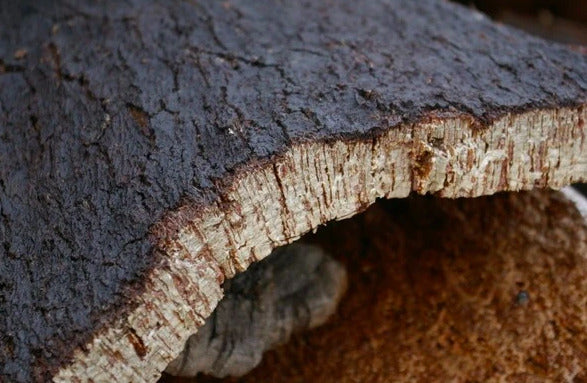
Cork is a material taken from a spongy layer, about 8 cm thick, found under the bark of cork oak trees, which are widely distributed in the Mediterranean region from Southern Europe to North Africa. Portugal, the world's leading producer of "cork," annually produces 200,000 tons of cork, accounting for 50% of the world's total production. Cork oak trees mature about 20 years after planting, and "cork" can then be harvested every 9 years. The lifespan of a cork oak tree is said to be 150 to 200 years, meaning that approximately 15 to 18 harvests are possible from a single tree.
Why is cork ethical?
Cork oak, which belongs to the category of non-depletable resources, is highly regarded from an ecological perspective for the following three reasons:
1. Can be harvested multiple times from a single tree

Harvesting "cork" from a single tree is not a one-time event. With "cork," it can be produced simply by stripping the bark, eliminating the need to cut down the tree itself. The "cork" can be harvested repeatedly as the stripped bark regenerates. As mentioned, the regeneration cycle of cork oak is about 9 years, and its lifespan is 150 to 200 years, allowing for approximately 15 to 18 harvests from a single cork oak tree.
2. Absorbs 3 to 5 times more CO2 than usual

Trees from which "cork" bark has been stripped absorb approximately 3 to 5 times more CO2 than usual to regenerate their bark. This contributes to CO2 reduction even during periods when harvesting is not possible.
3. A system that produces no waste

While "cork" is often associated with wine stoppers, it has a surprisingly diverse range of uses, including fashion, building materials, and even the aerospace industry. After "cork" is punched out in the shape of wine bottle stoppers, the remaining material is finely crushed into sheets. These then transform into bags or cork tiles. Almost all of the harvested "cork" is used in some form and not discarded.
From these points, "cork" is considered a highly environmentally friendly and ethical material.
Benefits of cork material
In addition to being good for the environment, "cork" also offers many material benefits.
Durable
"Cork" is a durable material, so much so that it is used as a building material for tiles and other applications.
When used in apparel products, the surface is treated, which further increases its strength, such as abrasion resistance, allowing it to maintain its original beauty over time.
Lightweight
"Cork" is said to be composed of over 50% air in its structure. This makes it extremely lightweight, while also possessing a unique elasticity and softness.
Water resistance
Cork is water-resistant due to its water-repellent properties. Its excellent water resistance can be imagined from its use as wine stoppers.
Since dirt can be removed with a damp cloth, it is easy to care for as an apparel product.
Of course, being "Vegan" is also a major appeal.
Summary
Hearing that "vegan fashion cannot use animal-derived materials like leather" might make it seem like choices are limited and fashion can't be enjoyed. However, as with cork, which we introduced this time, there are actually many attractive materials in the world that offer both functionality and design, even if we are not yet aware of them.
We hope to continue delivering bio-based materials that are not only kind to the environment and animals, but also cute in appearance and functional.
Reference: http://www.wineanorak.com/corks/howcorkismade.htm