


目次
Hello everyone! This is Karasawa, CEO of LOVST TOKYO.
With the start of April, I'm sure some of you have found a new rhythm in your lives. The weather has become pleasantly warm, making it a comfortable season.
Amidst all of this, we were finally able to release our highly anticipated products made with "aplena," apple leather from Aomori Prefecture. Thank you so much for your continued support!
Up until now, we had been developing products using "apple leather" from Italy, the country where apple leather originated. However, driven by your voices saying, "We hope you can one day achieve this with domestically produced apple leather!", we have finally been able to develop products using domestic materials.
Today, I'd like to share a little bit about the story behind the development of our products using domestic apple leather, "aplena," and what went on behind the scenes.

Photo taken when reporting the completion to Mr. Mori of Aomori Prefectural Government.
A Chance or Inevitable Encounter? Leftover Juice Pulp in Japan too!?
Exactly about a year ago, I received a call from a Mr. Mori, who was seconded from the Aomori Prefectural Government to Tokyo.
"Could LOVST TOKYO's apple leather products be developed domestically?"
Upon hearing more details, it turns out that some companies in Aomori Prefecture were already repurposing apple juice pomace into bioplastics and other materials.
Furthermore, JA Aoren in Aomori Prefecture, which supplies the raw material (pomace), is actually Japan's largest apple juice production facility, collecting and processing approximately 20,000 tons of raw apples annually. (If one apple is 250g, 80 million apples is an incredible amount!)

Apples awaiting processing (Photo taken at JA Aoren)
And approximately 6,000 tons of this is discharged as "residue," such as pomace, which is then dried and used for animal feed, among other things.

Dried pomace is fermented under the sun (Photo taken at JA Aoren)
So, we requested to use a portion of the pomace as a raw material for bio-leather, and the project began to move forward.
Incidentally, an innovative low-temperature plasma dryer, which has a lower energy load than conventional methods, has been introduced for drying apples.
This is also good in terms of the energy used to create upcycled raw materials!
Requesting cooperation from a reliable manufacturer.
The domestic apple leather development project thus kicked off, starting with finding a manufacturer who could cooperate in developing bio-leather.
Through my existing connections, it was Kyowa Life Techno Co., Ltd. who listened to our aspirations.
Kyowa Life Techno is a manufacturer that produces very high-quality synthetic leather as a branded synthetic leather for furniture and sundry goods, among domestic synthetic leather manufacturers.
Furthermore, at that time, although awareness of plant-derived vegan leather was gradually spreading in Japan, I believe there were still no manufacturers who were actually undertaking its development.
As a brand, and with Kyowa Life Techno as a material manufacturer, we aim to pioneer the domestic bio-leather market and convey our message to more people by fulfilling our respective roles. We are very happy that they took on this challenge with us from scratch, driven by this spirit of co-creation.
Furthermore, to expand the possibilities of materials, Kyowa Life Techno is not only developing apple leather but also bio-leather made from bamboo and shells.
(What kind of materials will be created next? We're very excited!)

Bio-leather development diagram (Provided by Kyowa Life Techno)
What makes domestic apple leather "aplena" different?
Those who have used our products before might wonder, "What's changed from the Italian-made ones?"
Simply put, there's no doubt that both are better materials than commonly imagined synthetic leather.
Both use highly durable resins compared to commonly imagined synthetic leather, making them resistant to hydrolysis. Both manufacturers are also developing them as branded synthetic leathers. (While general synthetic leather uses polyester-based PU resin, polycarbonate-based PU resin is used to make them highly durable. I'll summarize this in more detail in another article later.)
For example, "aplena" has even shown results that it can withstand a jungle test, which is a hydrolysis test, for 10 years!
Furthermore, as a domestic material, it can be procured with a lower environmental impact, so we believe that the carbon footprint will theoretically be smaller than before.
Summary
One of our commitments in running a leather brand is "materials."
To ensure transparency and quality, we have always worked directly with material manufacturers to develop products.
By incorporating high-quality materials from reliable manufacturers into our products, we have a strong desire for our valued customers to use them with affection for as long as possible.
It was a great honor for us as a brand to be involved with the manufacturer from the raw material procurement stage in this development of domestic apple leather!
(There are few brands that develop materials from scratch, and our ability to be so meticulous is thanks to the voices of everyone, the Aomori Prefectural Government, JA Aoren, and Kyowa Life Techno. Thank you very much, as always!)
Furthermore, we will continue to refine our brand's commitments and material development to bring even greater joy to all of our loyal customers!
We ask for your continued support.
LOVST TOKYO Karasawa
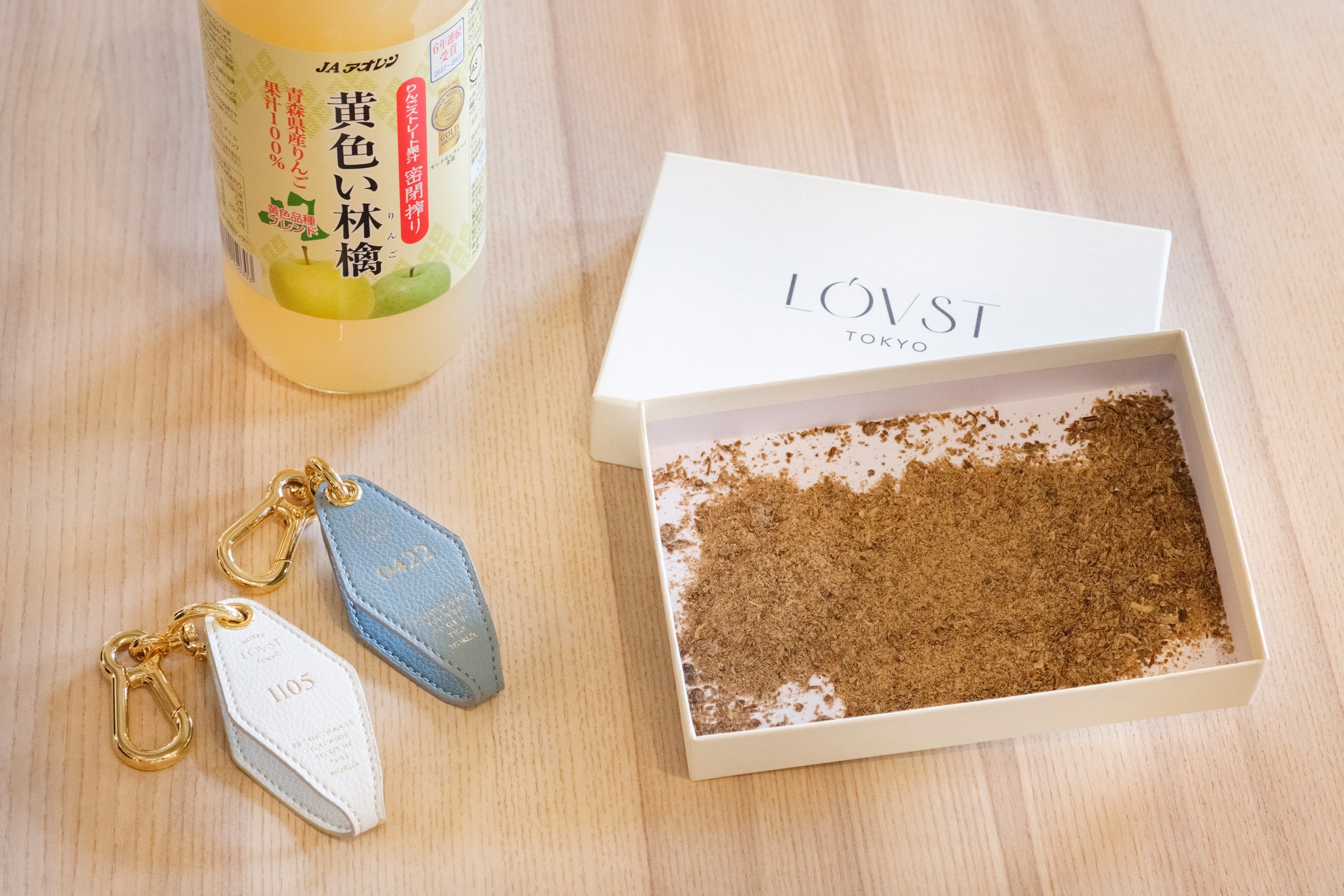
PS. I recently visited JA Aoren. Everyone at JA Aoren was so kind, and Aomori Prefecture was peaceful and wonderful. Their concentrated apple juice, which is the source of the raw material, is incredibly delicious!
I hope to be able to offer it to everyone at events someday ^^