


目次
Hello! This is Sugita, the Marketing Manager at LOVST TOKYO.
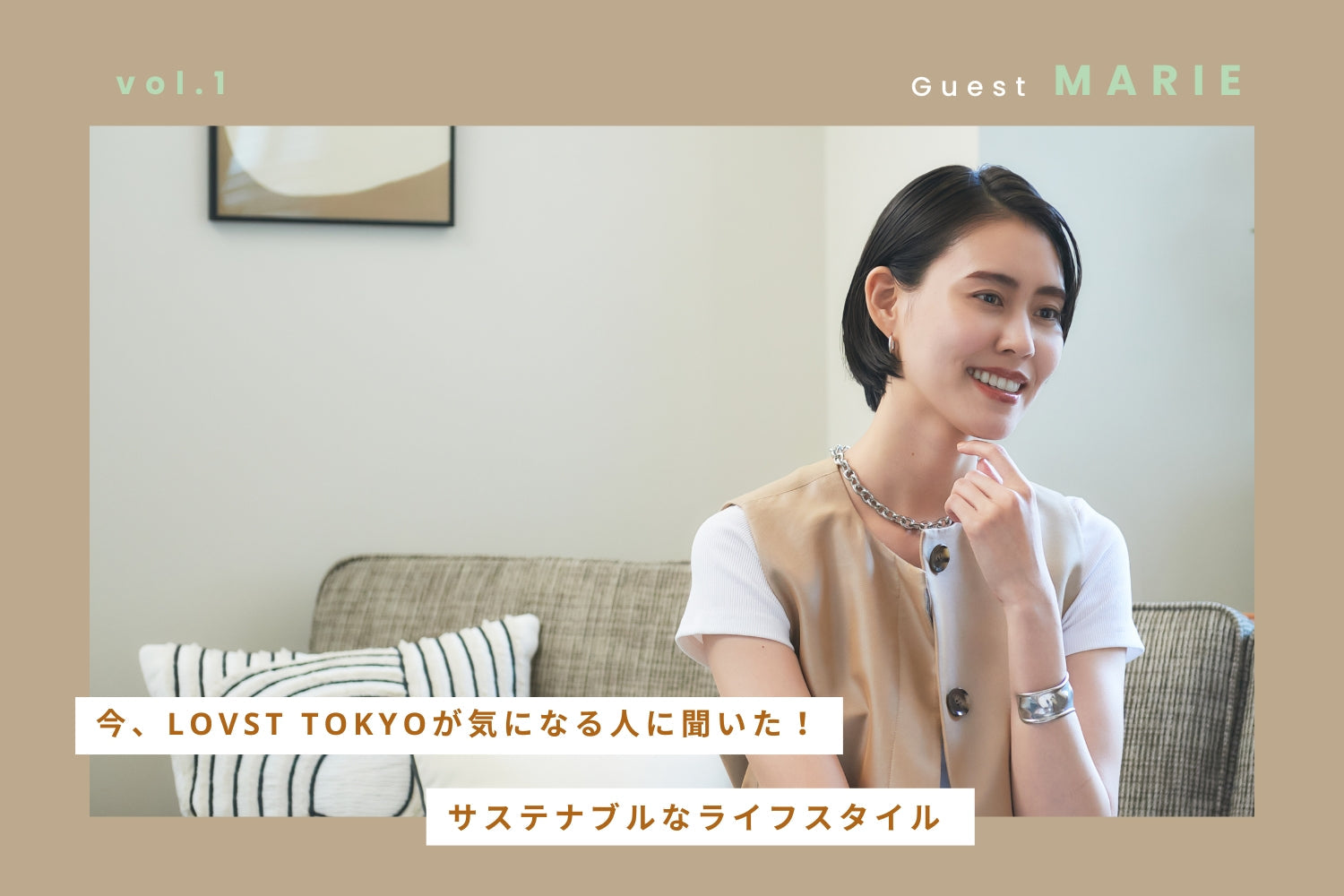
In this interview series, we invite guests who are currently attracting attention from LOVST TOKYO to share the sustainable actions they practice daily and what inspired them to adopt their current lifestyles. For our memorable first installment, we welcome model MARIE, who also appeared in our official Instagram reel.
MARIE, who has visited over 13 countries, discovered her awareness of environmental issues and the idea of starting a plant-based diet during her travels. We asked her about these experiences, how she manages living with family members who have different dietary styles, and her favorite vegan cosmetics, offering tips for enjoying a sustainable lifestyle every day!
The large amount of waste generated during travel sparked my concern for environmental issues.
Sugita: Thank you for joining us today! To start, could you please tell us what first sparked your interest in environmental issues?
MARIE: It started when I realized that I was generating more waste than usual when traveling, which I didn't like because I love to travel.
When you travel frequently, you tend to buy bottled water and use more trash bags than in daily life, right? As I traveled, I felt a sense of guilt about polluting the Earth, and I started thinking about how to reduce the amount of waste I produced.
That's when I started carrying reusable items like a "BRITA" water filter bottle, a "stojo" tumbler, and a "stasher" silicone case. This led me to consciously try to reduce waste in my daily life as well.
Sugita: It's true that you tend to generate more trash when traveling. You've traveled to over 13 countries. Which country left the strongest impression on you from a sustainable perspective?
MARIE: Koh Samui, Thailand. Surrounded by nature and coexisting with animals like cows, elephants, and chickens, life flowed at a relaxed pace. Naturally, my desire to live each day with consideration for environmental issues and animals grew stronger. In Thailand, I also participated in elephant rescue volunteering, which further prompted me to think about animal welfare issues.

Sugita: In Japan, rescued animals are typically dogs and cats, but what is the background behind the rescue of elephants?
MARIE: In Thailand, there are very famous tourist attractions where you can ride elephants and play with them. Some elephants get injured while performing at these attractions, and there are organizations that rescue them.
I once had an experience playing with elephants in the ocean, but at the attractions in the city, there were chairs placed on the elephants for people to sit on, and it seemed very difficult for the elephants. I felt a clear sense of discomfort seeing elephants being forced to work.
Sugita: That experience led you to participate in elephant rescue volunteering, didn't it?
MARIE: Yes. Even though it's volunteering, participants pay 40,000 yen and stay for a week to feed the elephants and clean the facilities. That participation fee is then used for rescue activities.
There, I was very impressed by the "enrichment" initiatives, such as setting food inside tires so that the rescued elephants could enjoy eating, which provided them with mental fulfillment.

Tips for effortlessly maintaining a plant-based diet
Sugita: Did you immediately start practicing a plant-based diet after you began considering environmental issues?
MARiE: No, my interest in vegetarianism was sparked by a "Small-Meal Fasting Course." In 2020, I was on a round-the-world trip, but due to the COVID-19 pandemic, I unexpectedly ended up staying on Koh Samui, Thailand, for about half a year. Since I had a lot of free time, I decided to take an online "Small-Meal Fasting" course that I had been interested in for a while. It was there, while learning about macrobiotic brown rice vegetarianism, that I first realized I could be healthy without consuming animal protein.
I love animals very much, and I felt that a plant-based lifestyle that doesn't sacrifice animals suited me very well. While researching veganism and vegetarianism, I also learned about the impact of animal agriculture on the global environment and animal welfare issues, so it was a very good opportunity.
Sugita: I think many people feel that vegetarianism is difficult to maintain once started, more so than taking the first step. How was it for you, MARIE?

MARIE: That's right. In the beginning, I actively incorporated vegan foods, using soy meat instead of regular meat. But the process, like rehydrating it with hot water, was too much and I couldn't keep it up. That's when I discovered deep-fried tofu (atsuage) from the supermarket. It's delicious just grilled, and also great stir-fried or simmered with vegetables. I love its chewy texture and always buy the same brand. My family's staple meal is that, along with stir-fried seasonal vegetables and mushrooms, and a combination of natto and miso soup.
Sugita: Atsuage is very convenient, isn't it? I heard that your family doesn't mainly eat vegetarian food. Do you prepare separate meals for your family at home?
MARIE: No, we eat the same meals. Thankfully, my husband is understanding of plant-based eating and enjoys the plant-based meals I cook. On days when my husband cooks, we sometimes have fish dishes, and I join him in eating those as well.
Sugita: You're very flexible in your approach. I hear that many people, not just with vegetarianism, tend to fall into a perfectionist mode when they start trying to live a lifestyle that considers environmental issues or animals, and they end up feeling distressed. How was it for you, MARIE?

MARIE: Yes, I did experience a period after childbirth when I found it difficult to continue my previous lifestyle. Being busy with childcare and work every day, my feelings for the future of the Earth and animals hadn't changed, but first, I had to figure out how to manage what I needed to do in front of me... I often hear the opinion, "Only people with economic and time余裕 can live a vegetarian or sustainable lifestyle," and at that time, I truly sympathized with that sentiment for the first time.
Sugita: Is there any trick that allowed you to continue despite that?
MARIE: First, I reset my previous assumptions and thought about what I could continue doing given limited time and money. As a result, instead of soy meat, I started buying readily available deep-fried tofu, and I began incorporating things that were easily accessible or quick to do into my daily life, such as using "Shabon Dama Soap" which doesn't affect ecosystems. By doing so, I was able to continue sustainable actions with peace of mind.
My shopping rules and what I keep in mind for beauty
Sugita: Please tell us if there are any other sustainable actions you practice regularly!
MARIE: When buying things, I try to look for secondhand items on "Mercari" or "Jimoty" instead of buying new ones right away.
For clothes, it's sometimes hard to find designs I like, so in those cases, I look for new items. When buying new clothes, I avoid fur and real leather, and I try to choose "Made in Japan" items, which helps support Japanese sewing technology.
Ethical and sustainable brands often make it easier to find such items, so I frequently check out "CASA FLINE" and "PUBLIC TOKYO." Also, whether the design can be worn for a long time is an important point for me.

Sugita: Thank you! If you have any favorite vegan & sustainable brands for cosmetics and skincare, I'd love to hear about them.
MARIE: Lately, I've been frequently using "bareMinerals" blush and "susurro" mascara.
bareMinerals's "CR Highlighter" is a vegan, cream-type blush that is free of UV absorbers. I like it because it blends well and gives a natural flush. My skin tends to be sensitive, so I try to choose cosmetics that can be removed with soap.
Also, susurro is also a vegan cosmetic. Their "Long & Curl Mascara" provides a subtle brown shade that gives a sophisticated look. I often get compliments on my eyelashes when I use this mascara, so I find myself reaching for it frequently.

From left: "bareMinerals" CR Highlighter, "foi" Eyelash Serum, and "susurro" Long & Curl Mascara.
Sugita: Many LOVST staff members also use susurro mascara. You mentioned that your skin tends to be sensitive, but I was surprised to see how fine your skin texture was when we met today! Do you have any particular skincare rituals?
MARIE: Lately, I've been using products from 'HERBAL SHOT,' a Thai skincare brand. Not only are they free of animal-derived ingredients, but they also exclude alcohol and parabens, which can irritate some skin types, and are rich in organic certified plant extracts. I love how gentle they feel on my skin, so they're my current favorites.
MARIE: Stress is the enemy of health and beauty, so I try to maintain a state of "holistic health." Holistic health refers to a state where mind, body, and environment are in harmony, achieving the best quality of life (QOL). I learned about this through a course I took at 'AWAKE&' previously.
When I feel a bit tired, I make sure to spend time doing things that make me happy. I love being in nature, so I refresh myself by going to parks and beaches in my daily life.
Sugita: Those moments are truly important, aren't they? Even a short walk can clear your head.

MARIE: Exactly. I also incorporate yoga, and even short sessions help balance my mind and body, so I can continue without feeling overwhelmed. Also, I try not to look at my phone before bed. When information constantly flows in, you unconsciously become overwhelmed with input, so I make an effort to rest my brain.
Sugita: I always end up looking at my phone before bed... I'll try to implement that starting tomorrow. Thank you for your time today, MARIE!
Sustainable options are surprisingly common
This time, we had the pleasure of interviewing model MARIE!
Many people who try to practice a lifestyle that considers environmental issues and animals find it much harder to sustain than to take the first step.
MARIE showed us that even when you're busy with work, childcare, and daily responsibilities, there are ways to continue without overstretching yourself. By letting go of what you considered normal yesterday and changing your perspective, you'll find that sustainable choices are surprisingly abundant in your daily life. We hope this article provides some helpful tips you can incorporate into your own routines.
[Editor's Note]
Thank you for reading the article to the end! I'm Fumi, the brand director who edited this piece.
MARIE shared some recommended information that I couldn't include in the main article but really wanted to, so I'll share it with you here.

It's MARIE's favorite vegetarian eatery, a Taiwanese vegetarian restaurant called "Kinshoku Shokudo" in Okinawa. Their chimaki (sticky rice dumplings) filled with peanuts, soy ham, and other ingredients are exquisite! The owner is also very kind, so if you're planning a trip to Okinawa, please check it out.
By the way, these chimaki can also be purchased online through the restaurant's X (formerly Twitter) account. I'm already planning to order some myself (laughs)!
<ACCESS>
Kinshoku Shokudo
1-7-9 Tsuboya, Naha, Okinawa
Hours: 8:00 AM - 3:00 PM
Closed: Thursdays