



目次
Hello everyone. This is Kaito Karasawa from LOVST TOKYO!
Recently, I've often introduced our items as using "apple leather," a plant-based vegan leather!
And when I do, I often receive comments such as:
"I hear a lot about vegan leather these days, but what exactly is it?"
"Is vegan leather really good for the environment?"
Thank you for asking!^^/
So today, I'd like to explain "vegan leather" and together, we'll consider whether it's not only animal-friendly but also truly environmentally conscious.
Vegan Leather Explained Part 1: What is generally called "leather"
First, what is generally called "leather" can be broadly divided into the following four types, I believe.
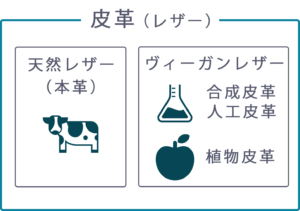
Natural leather (so-called genuine leather)
Natural leather, or genuine leather, is made from the tanned hides of real animals!
Several types of animals are used for natural leather.
- Cows: The majority of natural leather products circulated in Japan are cowhide.
- Pigs: Among various natural leathers, it is the only one with 100% domestic self-sufficiency.
- Deer: Deer leather is one of the oldest leathers produced in Japan.
In addition to these, there are also leathers from horses, kangaroos, sheep, and goats.
A major characteristic of natural leather is its durability and unique texture. Leather products made from animal hides, which protect animals from cold and impact, have a long lifespan and are said to last for over 10 years with proper care. Their texture and patterns are never identical, and they feature a unique, animal-derived aesthetic!
As for the price, it's not necessarily expensive just because it's leather; it varies greatly. "Raw hides," the source material, are purchased from livestock farmers, so prices fluctuate based on meat supply and demand, which is certain. However, leather from young calves, like "calfskin," which are slaughtered, is expensive due to its high quality.
Also, if the "leather" itself is a branded product, I believe its production is well-managed, so the price should reflect that. If it's a mass-market product, the price might not be as high as you think.
Synthetic leather (so-called imitation leather)

Structure of synthetic leather (from Tokyo Metropolitan Cleaning and Hygiene Business Association website)
Synthetic leather (or imitation leather) refers to a material that reproduces the look of genuine leather by synthesizing artificial fibers (polyester or cotton woven fabric) with resins such as PVC or polyurethane.
Compared to natural leather, synthetic leather can be mass-produced with stable quality. Since it can generally be produced in a uniform size of 1 meter width, there is less waste during product manufacturing.
The product lifespan is said to be about 3-5 years, but it varies depending on the quality of the resin used for the surface and the manufacturer's skill. Therefore, the price of synthetic leather on the market also varies greatly!
→I think the synthetic leather often used in affordable bags, like those sold by fast-fashion brands, is not very good quality and deteriorates very quickly.
Another major characteristic of synthetic leather is that it is lightweight and water-resistant.
It doesn't have the weight of genuine leather, and it doesn't require any particular maintenance even if it gets wet, making it more suitable for everyday use. And recently, due to the COVID-19 pandemic, there has been an increasing trend to use synthetic leather for items that frequently come into contact with skin, as it is superior to animal hides in terms of antibacterial properties!
Artificial leather (so-called artificial skin?)
Similar to synthetic leather is a material called artificial leather. Simply put, artificial leather can be thought of as an upgraded version of synthetic leather.
It shares the characteristics of being lightweight and water-resistant, but it has a texture that reproduces genuine leather more faithfully. Some varieties are said to last for 5-8 years or more, offering superior durability compared to synthetic leather. Consequently, the price is also higher than synthetic leather.
Artificial leather, like synthetic leather, is made from non-animal-derived synthetic fibers and resin, but the difference between the two lies in their manufacturing method.

Structure of artificial leather (from Tokyo Metropolitan Cleaning and Hygiene Business Association website)
While synthetic leather uses a woven fabric layer as its base, artificial leather constructs its base layer with non-woven fabric. Both share the common feature of applying a resin layer to the surface, but there are differences in their manufacturing methods.
However, once they are productized, the materials are bonded together, so it's impossible to tell them apart... Therefore, in the end, I think the product tag will state "synthetic leather" or "artificial leather," so please check that as well.
By the way, "synthetic leather" is also artificially made, so many brands actually refer to it as "artificial leather." I don't think there's any malicious intent, but I wish they would communicate with a clear understanding of the difference between synthetic leather and artificial leather... When I see brands calling synthetic leather "artificial leather," I sometimes wonder, "Won't that cause confusion?"
Plant-based leather (Bio-leather / Plant-based leather / Plant-derived vegan leather)
And finally, there's plant-based leather (plant-derived synthetic leather), which is a synthetic material made from decomposed plant raw materials and polyurethane resin.
Recently, bio-leather is being developed more and more around the world, and even I know of many types, such as apple, pineapple, mushroom, cactus, mango, coconut, grape, and corn! It's gradually gaining momentum!

Structure of Apple Leather
Furthermore, the manufacturing methods include processes like the "apple leather" we handle, where dried materials are broken down into particles and mixed with resin to form part of the raw material. Other methods utilize leaf fibers as a base fabric, with a resin layer laminated on top. There's also a method, like "mushroom leather," where the material itself is cultivated and grown.
Below, I've compiled articles on various plant-derived vegan leathers. If there's a particular plant or fruit that interests you, please check them out.
|
・Apple Leather: Italian Apple Leather "Apple Skin" ・Cactus Leather: Do you know about "Cactus Leather," the vegan leather derived from cacti? ・Grape Leather: Do you know about "VEGEA," the bio-leather derived from grapes? ・Pineapple Leather: Do you know about "Piñatex," the vegan leather derived from pineapples? ・Mango Leather: Do you know about "Fruit Leather," the vegan leather derived from mangoes? ・Mushroom Leather: Do you know about "Mylo," the bio-leather derived from mushrooms? ・Cork Leather: Do you know about "Cork Leather," leather extracted from trees? |
While the natural content (degree of biodegradability) varies by manufacturer, the growing interest in moving away from the livestock industry has led to the emergence of these partially natural materials as new alternatives to conventional synthetic and artificial leathers, which I feel is a very positive trend.
However, it seems preferable that these plant-based leathers are still labeled as "synthetic leather" or "artificial leather" in their official descriptions.
As far as I know, most plant-derived leathers are based on "synthetic leather." I've seen various bio-leathers so far, but it seems there aren't any currently manufactured based on "artificial leather" yet!
Vegan Leather Explained Part 2: "Why is it called vegan leather?"
Up to this point, I've introduced three types of leather other than genuine leather, and they all have in common that they do not use any animal-derived materials.
In other words, while synthetic leather, artificial leather, and plant-based leather each have different characteristics and manufacturing methods, they are all broadly classified as "vegan leather" based on whether or not they use animal materials!
Let me briefly return to the previous point: plant-derived vegan leather, such as the "Apple Leather (Apple Skin)" handled by LOVST TOKYO, also falls under the broad category of vegan leather.
Recently, there's been an increase in brands promoting generally inexpensive synthetic leathers as "vegan leather," so I believe it would be beneficial to remember that there are different types within vegan leather to make a better choice!
Even within "vegan leather," those promoted as branded leathers by manufacturers are quite good, I think. For example, the popular "Tenshi no Hane" school bags use Clarino, a vegan leather, designed to last over 6 years for energetic children!
This largely depends on the technical capabilities of the "vegan leather" manufacturers, but the Italian "Apple Leather (Apple Skin)" we use is from a leading Italian vegan leather manufacturer, so it produces reliable branded leather.
However, most plant-derived vegan leathers still lack efficient production systems and are comparatively expensive. Yet, considering they utilize waste materials as part of their raw ingredients, their environmental impact is smaller than conventional synthetic or artificial leathers made 100% from petroleum components. The fact that they share similar properties of being lightweight and water-resistant is still very appealing!
Vegan Leather Explained Part 3: "Is vegan leather environmentally friendly?"
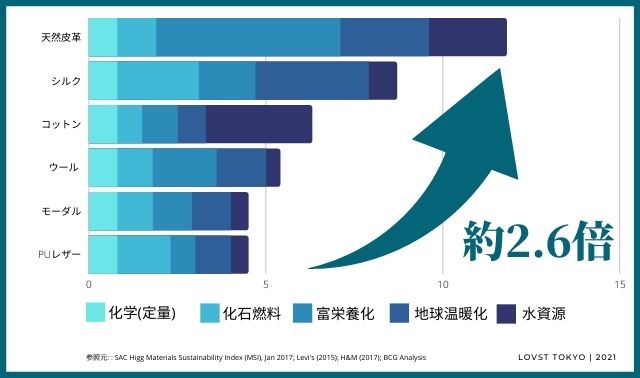
Finally, I want to consider the question of whether vegan leather is not only animal-friendly but also earth-friendly.
The figure above shows the environmental impact composition by material, referencing HIGG INDEX.
While natural leather (genuine leather) has high values for water resources, global warming, and other categories, PU leather (synthetic/artificial leather) has a lower overall impact, but its fossil fuel value is significant due to the use of petroleum-derived resins!
Considering the use of fossil fuels, it remains questionable whether typical vegan leather is a sustainable material. However, in that regard, plant-derived vegan leather might be a better choice as it reduces the amount of petroleum-derived resin!
However, it might be the case that such a view cannot be universally declared "correct" depending on the data referenced and various perspectives. Therefore, I will continue to study daily and strive to output these answers to all of you!
Vegan Leather Explained: Summary

Well, today we've discussed "vegan leather" together! It would be a great honor for me, as someone who runs a brand, if you've gained even a little deeper understanding of vegan leather!
Also, although it might be presumptuous to say this after writing all of that, we are still learning every day, constantly researching new materials, and striving to give shape to what we learn!
So, if you have any questions or concerns, such as "I found this material!" or "What about this?", please feel free to reach out!
We look forward to your continued support.
Kaito Karasawa, LOVST TOKYO